AI is no longer a promise, most organizations are starting their journey. Yet one reality is becoming clear: The challenge is no longer to start with AI. The challenge is to make it work at scale, in real operations, and with measurable impact.
The state of play
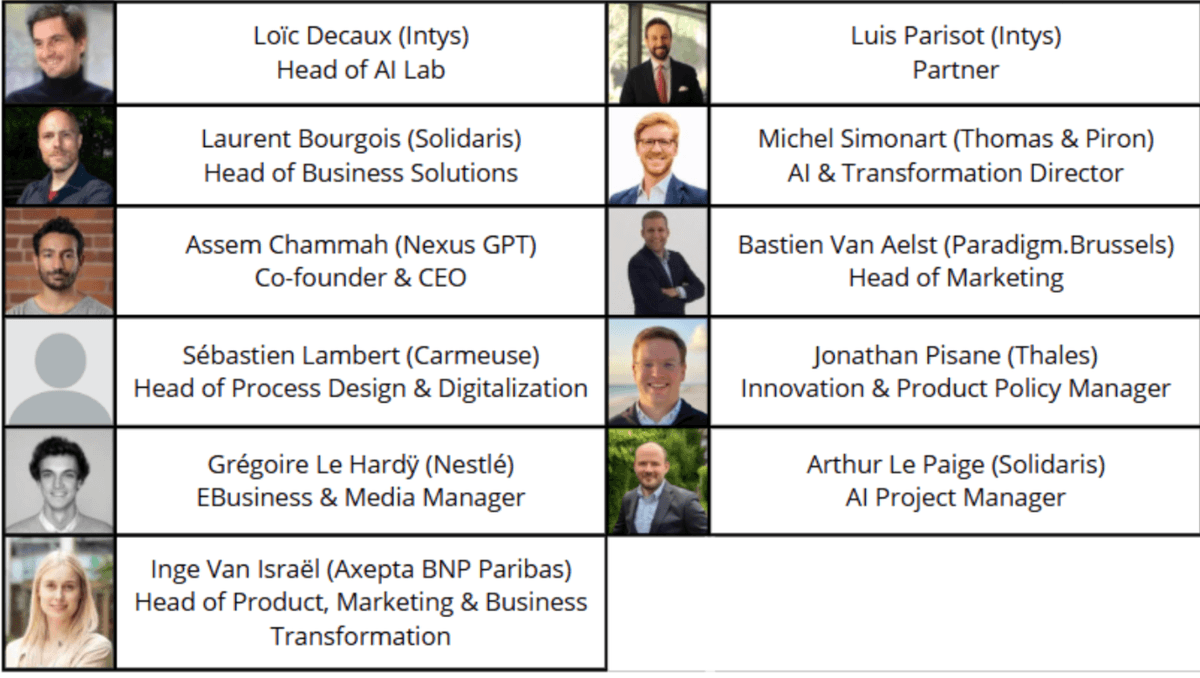
On February 19, Intys hosted a new cross-sector AI executive roundtable, gathering leaders from industry, finance, healthcare, telecom, construction and the public sector.
And yet, a common reality emerged from the discussion: the execution gap is widening. It is time to tackle the organizational, human, and cultural challenges of this digital transformation.
The POC paradox: easy to start, hard to scale
Proofs of concept are now everywhere, knowledge assistants, chatbots, internal agents,… Building a POC is no longer the challenge, moving from experimentation to reliable and scalable production is.
Building a POC in AI is relatively easy. Scaling it into a production-ready solution is the real challenge.
- Arthur Le Paige
The obstacles are rarely technological. Organizations struggle with unclear governance, security and data concerns, and, most importantly, the difficulty of adapting solutions to real operational processes.
Many participants already shared a common belief: we can build something in weeks but making it reliable, scalable and integrated will take much longer.
This confirms what we increasingly see across organizations: AI transformation is primarily an operational challenge, not a technical one.
Implementing AI is more about change management than about IT.
- Bastien Van Aelst
AI has proven its worth - from an operational perspective
De
spite the execution difficulties, concrete impact can emerge, here is one through AI implementation by an employee within an organisation.
- +50% conversion in a customer onboarding journey
- +10 points in customer satisfaction
- representing 15% of total sales
- These numbers are only the entry point. Combined with agility, AI has the potential to unlock much more business value.
Culture and people are becoming the real differentiators
Th
e maturity gap between organizations is no longer just about technology. Mindset and leadership now make the difference.
The most advanced organizations have gone through a deep cultural shift: they empower employees to experiment, dedicate time to AI exploration, encourage bottom-up initiatives, and progressively build internal ecosystems of agents and use cases. Others, however, remain held back by risk concerns and operate under very cautious governance.
The challenge now includes to find the right balance between strict governance and the freedom to experiment.
The mindset is top-down, but the initiative is bottom-up. Leaders provide direction while giving autonomy to the teams.
- Grégoire Le Hardÿ
But culture alone is not enough. The people dimension remains central. Most barriers mentioned during the discussion were not technical, but organisational: lack of executive sponsorship, resistance to change from teams attached to existing ways of working, fear around loss of control, and a lack of time, resources, or capacities.
At the same time, expectations are evolving. Younger generations often expect AI-enabled environments and can quickly be frustrated facing lagging organizations.
A missing role is slowing down execution - the BPO
A critical gap highlighted by multiple participants is the lack of a true bridge between business and technology which might translate needs into executable solutions.
Organizations need a profile who will understand, challenge and formalise processes end-to-end while piloting the AI transformation. As he closely works with operational teams, he is a facilitator and coordinator of the digital transformation.
The Business Process Owner is becoming a key success factor to move from isolated initiatives to sustainable and scalable transformation.
What we’re missing is someone with a clear application landscape view. Despite having strong experts, we still lack a clear vision of the expected outcomes.
- Laurent Bourgois
Scalability is what Intys looks for and will always do
If the 2025 roundtable was about understanding possibilities and identifying bottlenecks, this year’s discussion reflects a shift in priorities because the biggest risk today is to stay in experimentation mode for too long.
Turning ambition into real impact requires more than tools. It requires clarity of direction, the ability to rethink how work gets done, the right balance between governance and agility, and a strong focus on execution. This is precisely where our approach at Intys is built around.
-> Inspire : by empowering leaders and teams to clarify their ambition and unlock their potential through a shared vision of how AI can create value.
-> Innovate : by fostering a culture of continuous learning and experimentation, and by identifying practical opportunities that challenge existing ways of working.
-> Integrate : by turning ideas into reality, embedding AI into processes, governance, and daily operations so that innovation becomes tangible and sustainable.
-> Impact : by taking a holistic view of transformation and ensuring that AI delivers measurable, end-to-end business value across the organization.
At the core of Intys’ approach lies a key element: centralise the role of Business Process Owners to bridge strategy, technology, and operations, and ensure that AI creates real added-value.
What’s now and what’s after ?
This roundtable helped bring a clear reality into focus: the challenge with AI is no longer experimentation, but scaling.
Organizations are actively testing, use cases are multiplying, and the technology is widely accessible. However, real value now depends on the ability to integrate AI into business processes, evolve ways of working, and ensure adoption across teams.
The discussions also confirmed that the main barriers are no longer technical, but organizational and human: data quality and governance, use case prioritization, executive sponsorship, business adoption, and the ability to drive execution.
Finally, the roundtable highlighted that the maturity gap between organizations is no longer determined by tools, but by culture, leadership, and their ability to turn experimentation into sustainable operational impact.
As organizations strategically implementing AI, a new set of questions is emerging :
Who owns execution?
- Are our governance frameworks designed to enable learning and scale, or mainly to control risk ?
- How does work need to change ?
- Do our teams have the time, incentives, and support to integrate AI into their daily work ?
If you would like to continue this debate, explore these questions further, or confront them with your own organizational reality, we would be pleased to exchange with you.
Loïc Decaux - Head of Research, Development & Innovation Lead of AI Lab
Luis Parisot - Partner Intys